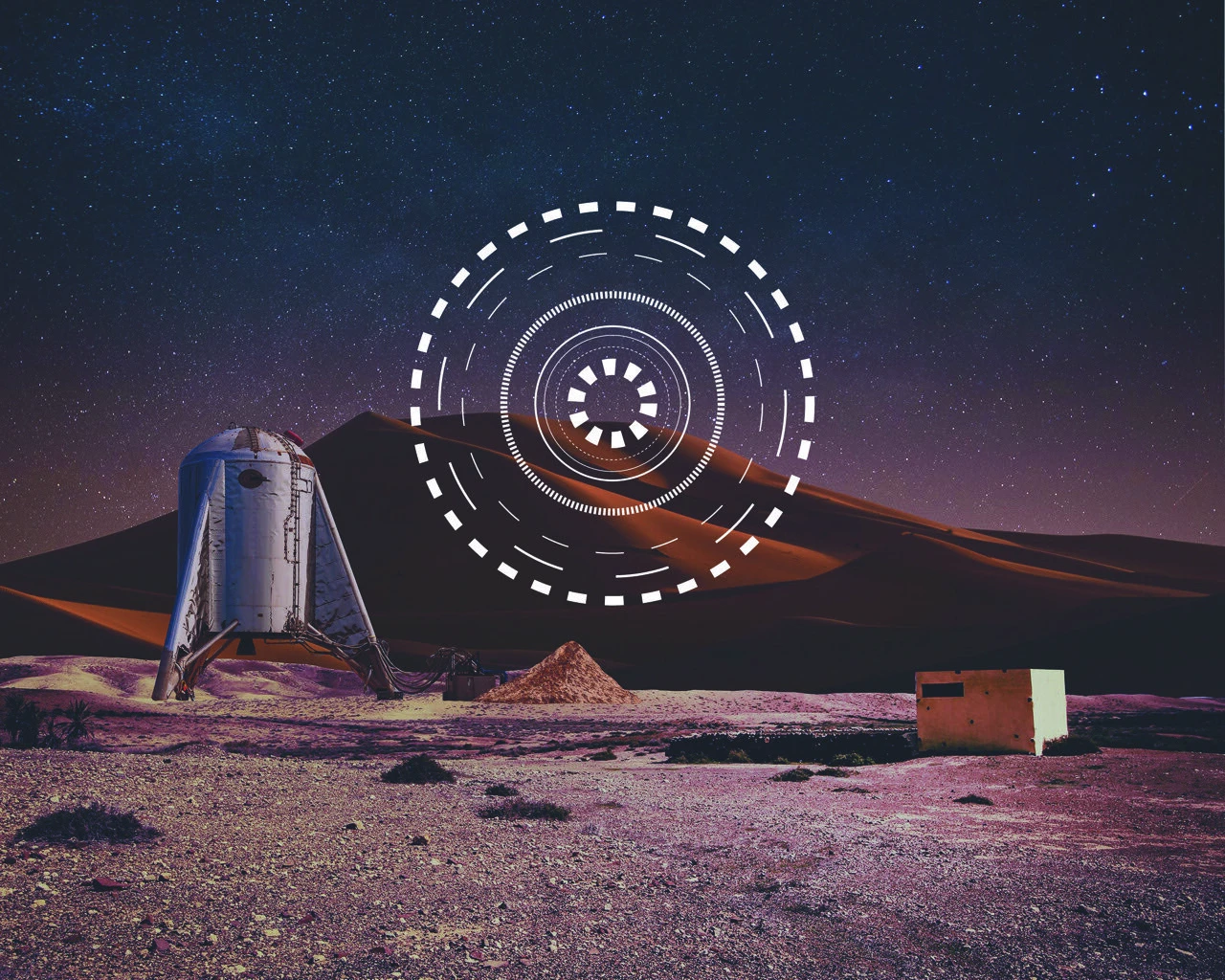
Really Large Numbers, The Silent Earth, 2019. Courtesy of the artists.
Really Large Numbers is the art/laboratory collaboration between new media artist Julia Oldham and installation artist Chad Stayrook. They have been working together since 2011 and their next ambitious project, The Observatory, will open on January 18, 2020 at Smack Mellon in DUMBO, Brooklyn. CHASM takes a moment with them to discuss their ongoing work and themes.
CJ: Can we start with dreams, since your collaboration began with a sequence of dreams about each other, can you describe them and do you keep dream journals to keep track?
RLN: Julia had the first dream. It was funny, because she hardly knew Chad at all at the time (we had been in one show together the previous year, where we met). She had a really stressful dream that the two of them were trying to feed each of the fish in the Baltimore Aquarium a single Japanese rice puff snack as they dinner, but we kept losing track of which fish had eaten and which hadn’t. Seven months later, in December, 2011, Chad emailed Julia that he had had a dream about being at a magical residency full of mythical creatures (including a centaur talking on the telephone at a phone booth), and Julia appeared in the landscape, doing some kind of gardening of reeds.
After this exchange, we started sharing dreams with each other regularly by email. Funny and fantastical ones, mostly. Because we were exchanging dreams, bits and pieces of each of our dreams started showing up in the other’s dreams. We called it our “Dream Thread,” and have used dream elements in many of our collaborative pieces. We’ve got a very long email history of shared dreams to draw ideas from.
CJ: Given the current state of affairs and history in general, it seems easier to envision a future dystopia than a future utopia. Agree or disagree?
Julia: I agree, absolutely. Reading about the fires in Australia has felt particularly post-apocalyptic. Something really bad is coming, and I think it’s way too late to stop it. We’re going to either have to adapt or die out. The latter seems like it might be better for the planet in general, but it’s also a very sad thought. My dad is part of a climate policy group in Maryland, and he has been helping to devise an energy plan for Frederick County. He has shared a lot of his research and planning with me, which ranges from hopeful to profoundly bleak.
Chad: I feel like dystopia and utopia go hand in hand, each existing on a fine edge that can easily tilt from one to the other based on perspective. The Observatory is probably an envisioned dystopia but I don’t see my character as one of the last humans on Earth as unhappy. To me he is more placatingly resigned to his fate and in some ways the whole thing is hopeful in that the AI will ultimately guide the world back to something habitable. That said, I do think that present political and (especially) environmental realities make it hard to be positive about our prospects on this planet. I’ve also been devastated by the destruction caused by the Australian brush fires, crying in my studio while watching Koala’s desperately seeking out water and safety. If The Observatory represents a dystopia for humans perhaps it also represents a utopia for other species and the possibility of a planet able to heal itself without human interference.
CJ: The twentieth century birthed a plethora of dystopian forms, from OrwellIian autocracy to Huxley’s totalitarianism to Kafka’s bureaucratic traps to Phillip K Dick’s virtuality to Ursula Le Guin’s fantasy alternate realities. Now we have James VanderMeer’s mytho-biological dystopias, postmodern fiction by Don DeLillo, speculative fictions by Margaret Atwood and Kim Stanley Robinson, among others. What literature informs your vision?
Julia: Oh, there are so many books to choose from! I’m an avid reader of speculative fiction, cli-fi (that’s climate change fiction, for the uninitiated) and dystopian future books written by female authors. Some of my favorites are The Parable of the Sower by Octavia Butler, Hollow Kingdom by Kira Jane Buxton, Cygnet by Season Butler, The Fifth Season by N.K. Jemison, The Uninvited by Liz Jensen, The Dreamers by Karen Thomspon Walker, Flight Behavior by Barbara Kingsolver, Good Morning, Midnight by Lily Brooks-Dalton and Station Eleven by Emily St. John Mandel.
Chad: I take most of my literary cues from Julia and pretty much read and love everything she suggests. Probably one of my favorite reads from the last five years and the one that I constantly think of when building new projects is the Remembrance of Earth’s Past, three novel series by Cixin Liu (commonly referred to as The Three Body Problem, the first novel in the series). It would be impossible to describe it’s Sci-fi breadth in this short paragraph but I love the poetic interpretations Liu gives to any number of scientific theories. The ending (described in more detail below) is one of the more interesting dystopian visions I’ve come across.
CJ: Given your background/s and interests in artificial intelligence, cosmology and physics, are there any particular theories that intrigue you the most? For example, Nick Bostrom’s simulation hypothesis? The Many Worlds Interpretation? Supersymmetry? Quantum computing? Panpsychism?
Julia: My favorite theory from 2019 is the idea that Planet Nine, a hypothetical planet in the far reaches of our solar system that may explain gravitational effects on a clump of trans-Neptunian Objects, is actually a black hole the size of a grapefruit. Black holes in general are of great interest to me, particularly because they are a serious point of contention between relativity and quantum physics, two of the rulebooks that we’ve developed to understand the universe.
Chad: My background in most things AI, cosmology, or physics is hobby-level at best and I won’t pretend to have much more than a below average understanding of many of the major theories. I am, however, fascinated by all the theories you mention here and more. And while I don’t gravitate toward any one in particular I absolutely love the language that is often used to describe these theories to the lay-person. It think that metaphorical language is where my particular interest in scientific theories exists.
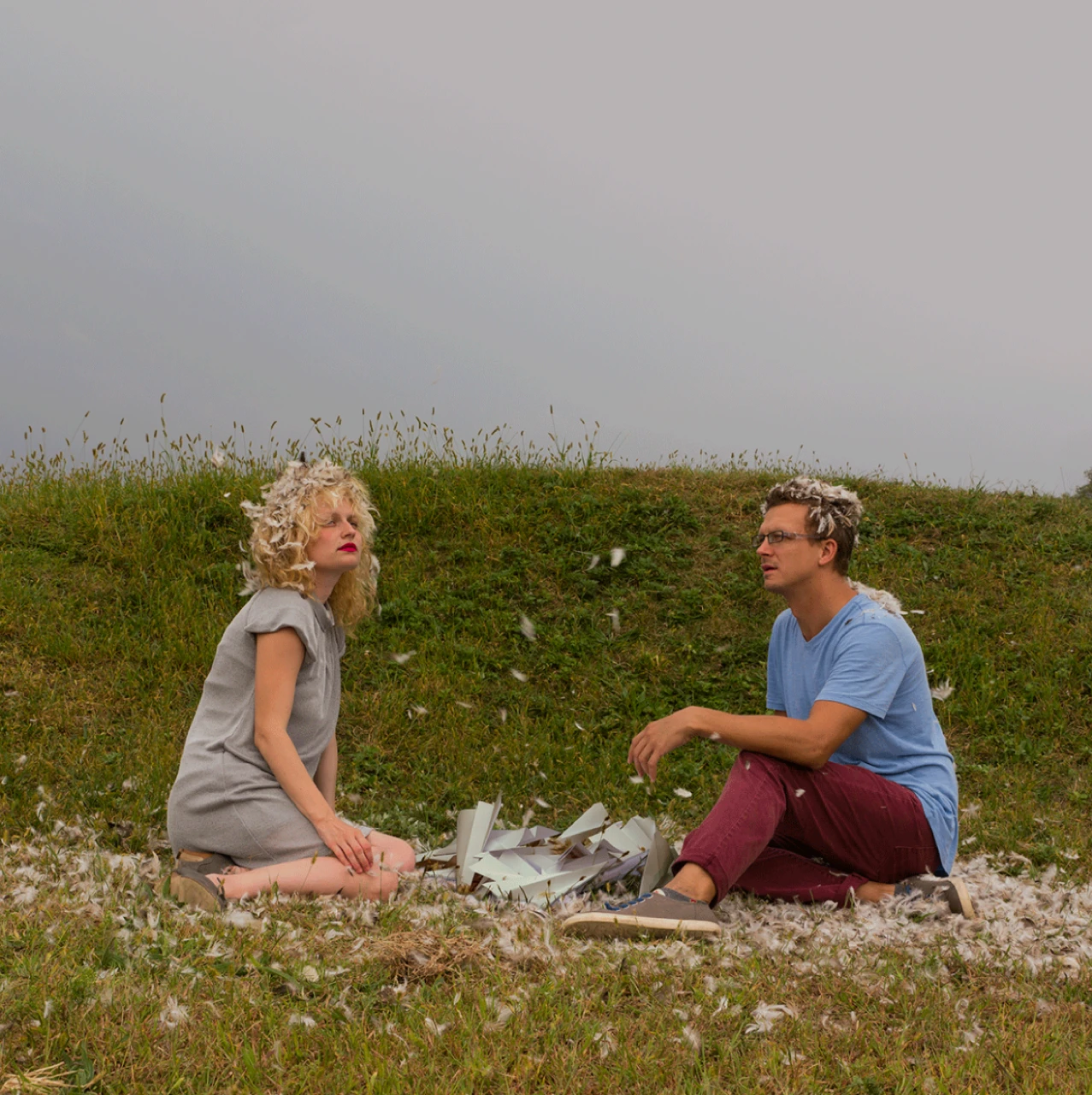
Really Large Numbers. Courtesy of the artists.
CJ: Thinking about different representations of AI in pop culture (Ex Machina, Her, etc) how are you making departures in your representation of artificial consciousness?
RLN: In The Observatory, human civilization has ended, but an AI system that was initially developed by humans has persevered and become independent. Terra, who is a “Steward” of a post-civilization Earth, is running a breeding program for humans, naked mole rats and other species that are capable of living on a desertified planet. It seems like it’s kind of a hobby to her; it’s definitely not a situation in which she is working for humans. She has her own agenda. It is important to us that she is not a female “helper” AI, developed to serve people (and especially men.) If we had to compare her to another popular culture AI, we might compare her to Hal from 2001: A Space Odyssey. But Hal has a programmed purpose, even if he veers from it. Terra makes her own rules. In this new world, she’s kind of like a God. Some of her characteristics were inspired by the AI called “Black Swan” in Chuck Wendig’s recent dystopian book, Wanderers. Over the course of the book, you discover that Black Swan is not working for anyone but itself.
CJ: What can audiences expect from The Observatory opening at Smack Mellon on Jan 18th?
RLN: The Observatory is a multimedia installation that combines large sculptural work that incorporates video monitors and forms a habitat for human occupants, and a three-channel video in which visitors will meet Terra, our AI character who is the director of the Human Repopulation Project. We are creating a post-climate-crisis, desertified vision of the world with our environment, and we’ll be covering all of the windows in the space with prints of an invented landscape that is related to the landscape you’ll see in the video work. We hope that visitors will be able to see themselves as the last humans on Earth, and that they will feel personally addressed by Terra, who will guide them through life in these troubled times.
CJ: To finish in classic dystopian fashion, perhaps we could discuss end of universe scenarios: heat death, crunch, collapse, big rip, vacuum decay… Which of these do you find more compelling and / or plausible?
Julia: One end of civilization scenario that I find particularly compelling, and that my dad told me about, is this: As a last ditch effort, we spray sulphur dioxide into the atmosphere to block the sun and reduce global warming. But we spray too much, and it brings on an extreme ice age.
As for the end of the universe, I will refer to Stephen Hawking’s final work, “A Smooth Exit From Eternal Inflation?”, which he submitted 10 days before his death. In this paper he predicts that our universe will fade into blackness as the stars lose energy. While this idea has received mixed responses from physicists, I find it to be beautiful, quiet and bittersweet.
Chad: In Cixin Liu’s “Death’s End”, many of the remaining civilizations in the cosmos retreat into these “pocket universes” to ride out the “big crunch” of the universe and the subsequent big bang of a “new” universe. These pockets are created out of matter from the larger universe and in creating so many of them, they deplete the universe from having enough matter to properly crunch (resulting in the big rip and ending the possibility of any life in the universe). In the end many are convinced to give up their pocket universes for the greater good of the entire universe so that it might reset itself with another Big Bang. It’s unclear if enough matter is restored to allow for the reset but the two characters we are left with at the end of the novel spend their last days flying through the great nothingness of space while watching it collapse in on itself. Again, beautiful, quiet, and bittersweet.