
Jasmin Kaur is a writer, illustrator and poet living on unceded Sto:lo territory. She is the author of the poetry and prose collection, When You Ask Me Where I’m Going (HarperCollins, 2019). Chasm Journal takes a moment to discuss Kaur’s newly released novel, If I Tell You The Truth (HarperCollins, 2021).
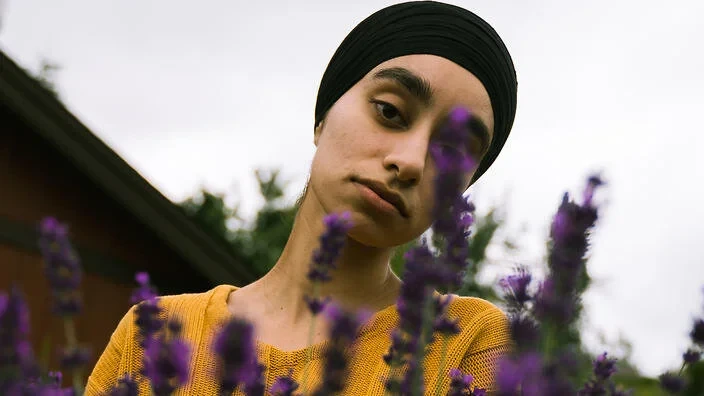
Portrait by Tajinder Kaur
Jessica Caroline: I’m writing to you at a time of historic upheaval in India, as millions of farmers unite in protest against Prime Minister Narendra Modi. In your latest novel, If I tell You The Truth, the political is personal, abuse and corruption is apprehended through the perspective of an immigrant Sikh woman from Punjab. How are you relating to these events from your point of view in Canada?
Jasmin Kaur: Growing up as a Sikh child in Canada meant learning about historical and contemporary revolutions in my motherland of Punjab. I remember being quite young—about eight or nine—when I first learned about the Sikh genocide of 1984. Older community members who lived through the genocide spoke candidly about the state violence our people experienced because they knew the consequences of suppressing the truth: a younger generation lulled into apathy about injustice. Being instilled with this awareness of social justice from a young age rooted me as I grew older and found my creative practise as a writer. I have found so much strength in Sikh and Punjabi activists and revolutionaries, so it’s intuitive that the stories I grew up hearing have shaped my own storytelling. When I wrote Kiran Kaur’s character in If I Tell You The Truth, one of my deepest inspirations was Bibi Resham Kaur, a Sikh woman who was sexually assaulted and extrajudicially murdered by Indian police in the winter of 1993. Although If I Tell You The Truth is a work of fiction, the state violence that my characters experience is just as real as revolutionary South Asian women like Bibi Resham Kaur, whose lives and deaths the Indian government would conveniently have us forget.
As we think about the farmer protests taking place in Delhi right now, it’s important to recognize the suppression of dissent, state censorship and custodial violence taking place—especially against marginalized South Asian women protestors. Nodeep Kaur, a Dalit trade unionist, was detained by Haryana Police on January 12th and her family reported that she was sexually assaulted while in custody. Nodeep’s experience is another startling reminder that police brutality in India is, in no way, a thing of the past. It’s infuriating that If I Tell You The Truth feels so timely, in this sense. It galvanizes me to continue writing books about women of colour speaking truth to power. We need these stories.
JC If I Tell You The Truth traces the lineage between mothers and their daughters, with vast differences in mothering dynamics. Can you explain how you wanted to portray these differences and convergences by interweaving poetry and prose?
JK I wanted to explore just how complicated motherhood and family and generational trauma could be. Kiran is a well-intentioned mom who loves her daughter fiercely, but she wasn’t raised with the parental love that she deserves. She carries trauma from her upbringing as well as trauma from violence she’s experienced. These traumas shape her fiercely protective parenting style and her daughter—like many of us would be in her situation—is vocal about how harmful it is.
There are moments in the story, in fact, when Kiran’s behaviour as a mom begins to mirror her own mom’s harmful actions. These are moments where I visually portrayed the cycle of generational trauma. History repeats itself if we don’t step in and actively root out toxicity.
It was challenging to portray the complex mothering dynamics in this book while I only have the lived experience of a daughter. I’ve occupied some parenting roles as an older sibling and public school teacher but I’ve never had personal access to the world-shaping role that a parent has over the emotional development of their child. I imagine that parenthood can be frightening. You are personally responsible for how a tiny human engages with life. For their emotional and physical wellbeing at every moment. I can imagine the constant guilt and fear that some parents must carry. There’s so much to unpack there. We don’t always think about that guilt and fear from our perspective as their children.
JC Trauma, secrecy and sacrifice are recurring threads between your first and second novels, specifically through motherhood. In If I Tell You The Truth, your second novel, the narrative begins with Kiran Kaur, a woman from Punjab, giving birth to her baby girl, Sahaara, out of wedlock, conceived through a sexual assault. Kiran defies her mother’s cold admonishment and becomes an undocumented Canadian immigrant after overstaying her student visa. Kiran’s estrangement from her homeland and her family coincides with her desire to connect with others experiencing her alienation and to give her daughter a dignified life. Can you discuss the complex relationships among women in the book? In addition to this question, I’m curious also about the ways in which Kiran’s mother oppresses her, and the way Kiran goes to great lengths to protect her own daughter from the misogyny and abuse that she encountered? And finally, your names are symbolic, could you explain to our readers the significance of the names Kiran and Sahaara?
JK I sat with the portrayal of Hardeep, Kiran’s mom for a long time, before and after writing the novel. In my first book, When You Ask Me Where I’m Going, I included a poem that spoke to white perceptions of South Asian families and how my fifth grade teacher belittled South Asian families with his close-minded perceptions of them. As I drafted If I Tell You The Truth, I knew that it was fundamentally true of my character Kiran’s life that her mother would be abusive. I also knew that there would be white readers who would pick up the book and decide that this abusive individual was abusive because of her ethnicity, as if abusive white parents don’t exist. I decided, early on, that I wouldn’t shape my storytelling around whiteness. I wouldn’t spend hours teaching white readers how to deal with their own biases when, at its core, this book was written for South Asian women.
I very conscientiously gave Kiran a matriarchal family in Canada. She lives with a widowed Punjabi mother and her daughter Joti, a queer woman who becomes a sister Kiran. Sahaara, Kiran’s daughter, grows up in an imperfect home, but one filled with love and safety. It’s the space that she and Kiran deserve. In the face of so much generational trauma, I wanted to give them a safe haven and a powerful reference point for what a home should feel like. I think that Kiran needed to live with in a home with woman-identified people to feel safe after experiencing cis-male violence. Her perceptions of motherhood needed to be redefined by Joti’s mom, who showers her in much more love than her biological mother ever did. Sahaara has internal struggles as a teenager, but she is grounded by her loving family as she navigates them, and this makes all the difference.
I was also conscientious about how I named Kiran and Sahaara. Kiran means “ray [of light]” in Punjabi. It is an homage to Jyoti Singh, famously known as Nirbhaya across South Asia. The 2012 gang rape and murder of Jyoti Singh in Delhi sparked a powerful wave of protest in India. Young women and their allies actively challenged victim-blaming rhetoric that suggested that South Asian women would be safer if they simply stayed home, if they didn’t hang out with male friends, if they only wore certain types of clothing. I wanted to honour Jyoti Singh and all of her allies through Kiran. I wanted to channel the momentum of their collective voices. I named Sahaara in a similar spirit. In Punjabi, Sahaara means “support” or “refuge”. Kiran gives birth to Sahaara at a time when she is searching for a pillar, a sense of shelter and safety. Her daughter comes to embody that safe space. She is the first biological family member to Kiran who shows her authentic care. I think the name is so fitting for her nature.
JC Arundhati Roy is an inspiration to your characters and in your narrative style. Our readers may not be aware that Roy also had a brief stint as an actor, and at times the comical moments in your book reminded me of In Which Annie Gives it Those Ones, a film about architecture students in their final year of college. The film was part autobiographical, and at one point Roy’s character quips: “I have a talent for telling people they're full of crap.” I always loved that line, because she is essentially playing a version of herself. When was your first encounter with Roy’s work?
JK I first encountered Arundhati Roy’s work when I was a young university student. The thought of becoming a novelist hadn’t even crossed my mind at that point, but I was just beginning my journey as a poet. I was deeply inspired by this outspoken woman who was simultaneously a formidable activist and storyteller. One year, I had the opportunity to listen to Arundhati speak live in Vancouver as she discussed her experiences being detained by Indian police because of her unapologetic essays and writing about Indian state violence. This was an awe-inspiring moment for me, as I reflected on the power of storytelling—the Indian government was so terrified of a storyteller that they had her arrested. As I’ve continued to cultivate my craft, I’ve drawn a lot of strength from Arundhati’s bravery in the face of censorship and state subjugation. I know what is possible for my stories.
Simultaneously, as my understanding of social justice politics has grown from my budding poet days, I’ve come to recognize that it’s unhealthy to idealize any activist. Last year, Arundhati Roy was challenged by Dalit activists on her suggestion that she is “not a Brahmin” because her father converted to Christianity. Despite her Christian faith, it would be unfair to suggest that coming from a lineage of upper-caste Indians resulted in no generational class privilege for her and her family. I think that this example, among others, is a reminder of how we need to be willing to question and disagree with those who we place on pedestals. I think there shouldn’t be pedestals to begin with. Reverence undoubtedly leads to heartbreak, but it also leads to a greater problem: hierarchy in activism. We are all fallible and each of us should be willing to listen to our communities when we have space for growth.
JC I do agree. With this in mind, I wonder what you make of Roy’s widely circulated essay, ‘The pandemic is a portal’, in which she writes:
Nothing could be worse than a return to normality. Historically, pandemics have forced humans to break with the past and imagine their world anew. This one is no different. It is a portal, a gateway between one world and the next.
Do you share her sentiments here?
JK I think of farmer protests in Delhi. Right now, we are witnessing thousands upon thousands of marginalized farmers mobilize against state bills that will further disenfranchise them. Doctors who have been doing seva (selfless community service) at the Delhi protests have chillingly noted that while social distancing can’t take place with protestors living in such close quarters, many farmers recognize that they are protesting for their lives and livelihoods by challenging these farm bills. As many as 42,480 farmers and farm workers in India committed suicide in 2019, alone. This is a movement driven by marginalized communities who do not have the privilege to stay home during a dangerous pandemic. As Roy says, humans are breaking with the past and imagining the world anew, and it’s taking place in economically dire, violent circumstances.
JC What other writers and poets have been formative for you with this particular story?
JK Trista Mateer’s poetry and prose collection Aphrodite Made Me Do It was a source of inspiration for me. This story of self-care and love takes place as a conversation between the Greek goddess Aphrodite and the narrator. I was struck by the conversation around hyper-sexualization of woman-identified bodies. Even an all-powerful goddess was not spared from the violence of the male gaze. I drew strength and fire from this poetry collection as I wrote If I Tell You The Truth.
JC Your cross generational story moves back and forth in time and even projects into 2021. In the end notes of the novel you write about the impact of Covid on the story and on the lives of undocumented immigrants like Kiran. What are your future hopes and dreams for your characters, Kiran and Sahaara, and, if it’s not impinging too much on your privacy, for yourself?
JK I hope that Kiran and Sahaara get the solace and stability that they’ve always deserved. I especially hope that Kiran finds healthy love. She deserves a partner who always makes her feel safe. She deserves to be selfish, giving herself space to explore love after so many disappointments in her youth.
As I’ve set down If I Tell You The Truth as a writer and picked it up again as a reader and audiobook narrator, I’ve found my own courage renewed by my characters’. I hope that I can channel Kiran and Sahaara’s bravery into my own life, and continue to speak difficult, unsettling and necessary truths.